How to Get a Beauty Salon License in Texas
Before opening your doors, Texas law requires a TDLR Establishment License for any location offering cosmetology services. Here's exactly what you need — fees, equipment, and application steps all in one place.
In Texas, a beauty salon license is officially called a TDLR Cosmetology Establishment License. The application fee is $78 (non-refundable), submitted online at tdlr.texas.gov. The license is valid for two years. The owner does not need to be a licensed cosmetologist — but every practitioner performing services must hold a valid individual TDLR license.
Types of Texas Beauty Salon Licenses
TDLR regulates several types of cosmetology establishment licenses. The right choice depends on the services offered and how the space is structured. Most traditional beauty salons apply for the Full-Service Establishment License.
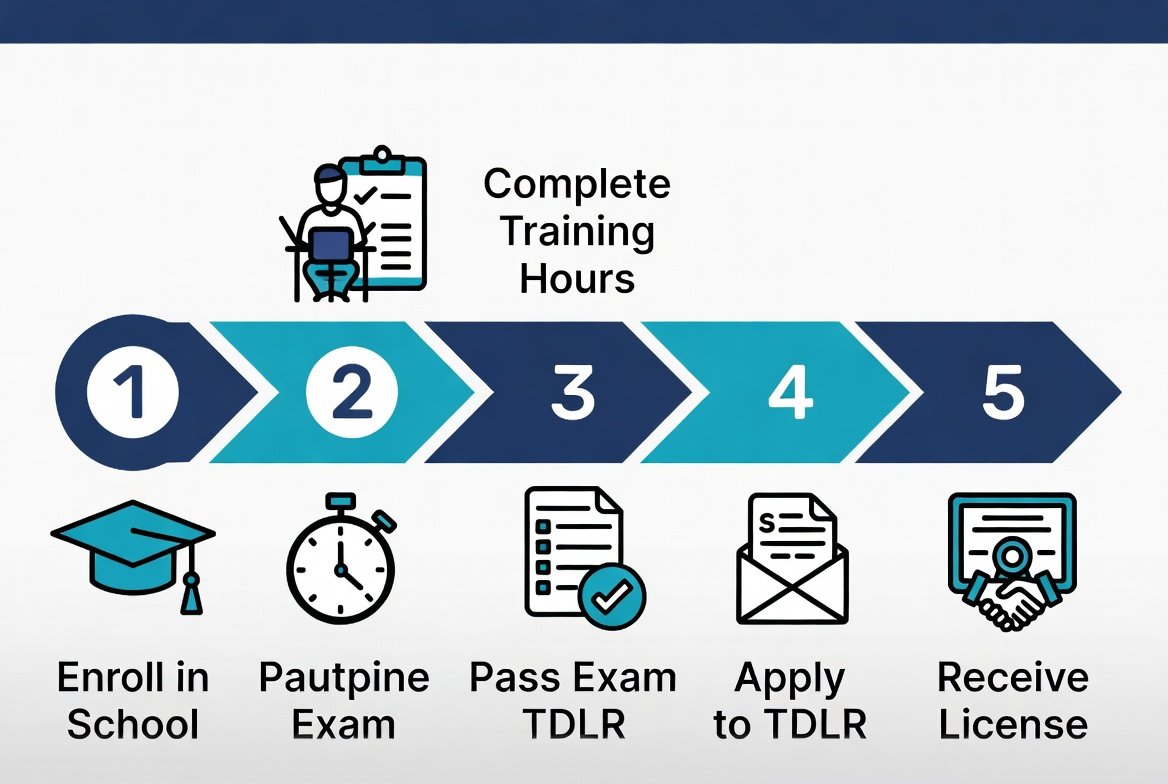
Step-by-Step Application Process
TDLR encourages online applications for faster processing. All requirements must be met within one year of the application date or the application is automatically voided.
Secure Your Business Location
The establishment license is tied to a physical address. Have a signed lease or proof of ownership ready before applying. If the salon is attached to a residence, a separate entrance is required — and any interior connecting door must remain closed during business hours.
Gather Business Ownership Documentation
The application requires legal names and addresses for all business owners, the entity structure (sole proprietorship, LLC, corporation, etc.), and the business's FEIN or SSN. Have these documents ready before starting the application.
Submit the Application and $78 Fee
Apply online at tdlr.texas.gov/App_Online/ — online applications process faster than mail submissions. Alternatively, download the Establishment License Application PDF and mail with a check or money order.
Set Up Required Equipment
For a full-service salon: a work station, styling chair, and shampoo bowl per license holder performing services, plus all general facility requirements (see the equipment section below).
Post Required Signage and Documentation
Once licensed, display: establishment name sign, human trafficking notice, consumer complaint sign, and most recent TDLR inspection report notice. The Laws and Rules Book ($14 from TDLR) must be on-site at all times.
Prepare for Unannounced TDLR Inspections
After licensure, TDLR conducts unannounced, risk-based inspections. Review TDLR's public inspections guide and do an internal compliance walk-through before opening. Violations can result in fines starting at $500 per violation.
Equipment & Facility Requirements
Establishment owners are responsible for providing specific equipment for both clients and practitioners. Requirements apply to the facility itself as well as to each individual work station.
💇 Per License Holder
- Work station
- Styling or barber chair
- Shampoo bowls Must be sufficient for the services offered
🏢 All Establishments
- Non-porous flooring in all service areas Required in restrooms and chemical mixing areas
- Sink with hot and cold running water Must be in or adjacent to the service area
- Restroom on or near the premises
- Wet disinfectant soaking container
- Clean, dry storage area
- Covered trash container
- Receptacle for used towels and linens
- Adequate ventilation and air filtration To keep chemical fumes away from the public
- Sterilization equipment (if nail services offered) Autoclave, dry heat sterilizer, or UV sanitizer
📋 Required Signage & Postings (Displayed Prominently)
- Establishment name sign
- Inspection report available notice
- Human trafficking awareness sign
- Consumer complaint sign
- Laws & Rules Book on-site at all times
- Each practitioner's license at their workstation
Renewals, Inspections & Staff Licensing
Getting the license is step one. Keeping the establishment in good standing requires ongoing attention to renewal deadlines, staff license status, and TDLR compliance requirements.
Establishment License Renewal (Every 2 Years)
The TDLR establishment license must be renewed every two years through the TDLR online portal. Letting the license lapse exposes the business to fines and enforcement action. A full guide — Texas Cosmetology Salon License Renewal — will cover the renewal process in detail.
Unannounced TDLR Inspections
Inspections are risk-based and unannounced. Inspectors verify equipment compliance, signage, sanitation, and the validity of every practitioner's individual license. Repeat or serious violations can escalate to fines of $500 or more per violation and potential license action.
Staff License Monitoring
Establishment owners are responsible for ensuring every practitioner holds a valid, current TDLR individual license. Operating with an unlicensed or expired practitioner is a violation attributed to the establishment. Verify staff licenses regularly through the TDLR license lookup at tdlr.texas.gov.
Practitioner CE Requirements
Individual practitioners must complete 4 hours of TDLR-approved continuing education per renewal cycle (2 hours for those licensed 15+ years). Non-compliant staff cannot legally renew — affecting their ability to work in the establishment. Learn more in the guide on the 4-Hour CE Requirement for Texas Cosmetology.
Changes to Ownership, Name, or Location
Any change in business ownership, business name, or physical location requires a formal notification and application to TDLR. The establishment license does not automatically transfer. Failure to update TDLR records is a compliance violation.
Frequently Asked Questions
Not necessarily. A Full-Service Establishment License covers the broadest range of cosmetology services — hair, skin, nails, waxing, and eyelash services — under a single license. Specialty Establishment Licenses are appropriate for businesses offering a narrower scope, such as an esthetician-only spa. Most general beauty salons choose the Full-Service license for maximum flexibility.
Yes. Texas law does not require the establishment owner to hold an individual cosmetology license. However, every person who performs cosmetology services on a client — whether an employee or independent contractor — must hold the appropriate valid TDLR individual license for the services they provide.
Yes, with specific conditions. A home-based salon must have a separate, distinct entrance from the residential portion of the property. Any interior door connecting the salon to the home must remain closed during business hours. The salon space must also meet all standard TDLR equipment, sanitation, and signage requirements.
TDLR's formal inspection program is post-licensure and conducted unannounced. However, all application requirements must be satisfied within one year of the application date. Owners are strongly encouraged to review TDLR's published inspections guide and complete an internal compliance check before opening to avoid citations.
A Mini-Establishment License allows a licensed cosmetology professional to operate as an independent contractor within a larger licensed salon. The mini-establishment must be physically located inside a licensed full-service or specialty establishment. The fee is $70, and the license holder must still meet all equipment requirements for their designated space.
Operating a cosmetology establishment without a valid TDLR license is a violation of the Texas Occupations Code. TDLR can issue citations, impose administrative fines, and pursue enforcement action — including cease and desist orders — against unlicensed establishments. Practitioners working inside an unlicensed establishment may also face individual license consequences.
Keep Your Individual License Current
Every practitioner working in the salon must maintain their own TDLR individual license — and that means completing CE hours before each renewal. Our TDLR-approved online courses make it simple to stay compliant.